Individuals + Couples + Psychedelics
I coach individuals into radical responsibility, presence and flow — and couples into deep, expansive intimacy.

My mission is to help men and women use their relationship struggles as the ultimate catalyst for their personal healing and evolution.
I support them to face their shadow and embrace all of their parts with radical compassion.
I give them permission to finally feel their feelings and become radically present to what is.
I guide them into their truth and power so that they can live authentic, self-directed lives from the inside out.
1:1 Work
I work with individuals to:
👉🏼 Use every relationship challenge as fuel for their growth
👉🏼 Heal their relational wounds + overcome trauma
👉🏼 Deepen their relationship to their bodies + Self
👉🏼 Access their power of vulnerability
👉🏼 Lead with healthy masculinity / femininity
👉🏼 Increase presence + flow
👉🏼 Embrace conflict
Couples Work
I work with couples to:
♥️ Practice what I call “Psychedelic Listening” to expand their hearts + minds
♥️ Embrace each others’ fears + speak and receive each others’ truths
♥️ Build polarity between the masculine + the feminine
♥️ Relax the parts of themselves that get triggered
♥️ Allow themselves to be seen + held in totality
♥️ Learn how to hold space for each other
♥️ Appreciate all of their parts
♥️ Create safety + security
Mini-Retreat at the Healing Cottage
I facilitate deep healing meditation sound journeys.
🔊 Sink into embodied knowing beyond intellect + philosophy
🔊 Allow the divine healing wisdom of your body to lead
🔊 Resolve unhealed trauma + relational wounds
🔊 Resonate with your soul + the universe
🔊 Activate your inner healing intelligence
🔊 Hosted in Upstate New York
🔊 Experience self-love
I’m guided by:
🙏🏼 Spirituality + Mindfulness
🙏🏼 Trauma + Somatic Work
🙏🏼 Masculine/Feminine Polarity
🙏🏼 Internal Family Systems (IFS)
🙏🏼 Therapeutic Psychedelics
“Combined with his authenticity, compassion and therapeutic approach, Saadya has proven to be an exceptional coach.
Saadya has been able to help me open up new avenues of transformation. My personal growth and development has truly been astounding. I highly recommend coaching by Saadya.”
“Thank you so much for our sessions thus far. I have not found traditional couples therapy helpful for me but this form of counseling with you has helped me in ways I can’t even begin to explain, to feel understood and give me much perspective.”

“My coach (healer) Saadya, one day lovingly said, “it’s time to get the f*ck off Adderall.” I’m so grateful that I did. I now feel so alive and present. It’s like I took off really dirty glasses and can see everything around me clearly. The best way I can describe then and now? That was death, this is life.
There are certain people that have a healing soul. Simply being in their presence is nurturing. Saadya is one of those people. When experiencing severe lows, he is able to walk me through it and guide me back to conscious presence with simple yet powerful techniques. His intuitive wisdom often picks up on highly important details that I myself am not yet aware of and empowers me with a new perspective.
I still go through the natural lows and highs of life. But now I have the tools that I learned from Saadya to walk myself though it and respond in a healthy way. And when I can’t do it myself, he’s always there to bring me back to the here and now.”
“I wanted to let you know how invaluable and powerful the journey experience was for me. I had heard and read a lot about set and setting, the importance of an experienced, compassionate guide, etc. But I was still surprised at how deeply I felt how absolutely crucial these things are.
In the time leading up to the journey, the journey itself, and afterwards, I truly felt that I was in the best hands possible. The journey itself taught me things about myself on an indescribably deep level, and after the fact I could not imagine having worked with anyone else other than you. Thank you!”

“Saadya has a very nuanced understanding of the human experience. With his tremendous love of people, he has the beautiful and unique blend of being as un-intimidating as he is wise.
I work with Saadya to address my fear and anxiety and with his unique approach I quickly discover its source, giving me the chance to reframe it and leave empowered. Through powerful questions and deep intuition and insight, he helps me to return to my self, to be fully in my body, embracing the present moment, and to act from my empowered masculine self.
He has a deep understanding of what most couples don’t even know they’re struggling with - particularly male/female dynamics, codependency, and what it is that kills the polarity in a relationship.
If you’re considering working with Saadya as your coach, don’t hesitate. Your investment will pay dividends in your relationship to self and others. You are worth it!”
“During our sessions, you were completely present, non judgmental, compassionate and so authentic. You made me feel empowered, worthy and important. I feel happier and more at peace with myself.
Thorough the last two sessions, I noticed that I was becoming more aware of myself, my thought process, my actions and the feelings of tension that I feel in my body.
Being coached by you taught me to have more self compassion, self love and an awareness of my capabilities to grow and continue to pursue my dreams. I’m more present throughout the day and that’s because of our time together. I’m ready to be me, embrace me completely. I’m ready to be fully present, and continue to follow my intuition, trust the process.
In conclusion, I’m truly blown away by you and the way we connected. I’m inspired. I feel powerful. And I’m ready to keep on growing while practicing self love, and self compassion.”

“I am nearly 50 years old, a grandfather, and I have been steeped in recovery and self-development work for at least 30 years. I have read hundreds of books and courses on self-help and have mentored and coached hundreds of business people.
I’ve worked with a coach for nine months to do inner-child work. I have taken almost every kind of psychedelic in various settings over hundreds of trips. Ten years ago I even hired a 75 year old psychiatrist in Manhattan to guide me on two MDMA-assisted psychotherapy sessions.
Still none of those experiences even scratched the surface relative to the coaching and medicine work I did with you.
My sessions with you were absolutely profound and priceless. For the first time ever, I met my inner-child - at nearly 50! - and had hours long dialogue with him. This has brought me so much healing and has improved my relationship to self, my relationship with my wife and my relationship with the world.
What I now understand is just how critical the therapeutic set and setting is. And how important the guide is in holding me in a safe container so that I can truly surrender. You did that flawlessly.
Everything about your process and presence was flawless. The preparation, intention setting, the space, the lighting, the music, the bed, the food, the nature walk, the integration and your guidance throughout - all of it allowed me to fully let go and heal.
You are deep and wide and took me to places I could not, would not and did not go on my own.
Thank you,
with Love,
keep shining bright ❤️”
“Thank you for the past journey we did, where I was that little girl feeling so unseen, so desperately wanting to be noticed by those who love me, and feeling so hurt that it didn’t happen. I thought it was just associated with my parents, but I’m realizing that it’s a deep wound that I’ve carried throughout my life. And when something happens that triggers it, it’s a harrowing reopening of that wound.
The therapist you referred me to started helping me safely go there to start healing it. And it might’ve taken me much longer to get there had I not entered that journey under your guidance. I know it’s going to take work, but I want to heal, and so I’m going to do it.
Thank you for everything you did that night to help me journey so safely and deeply. I’m filled with immense gratitude. Hashem should bless you ad bli dai 🙏.”
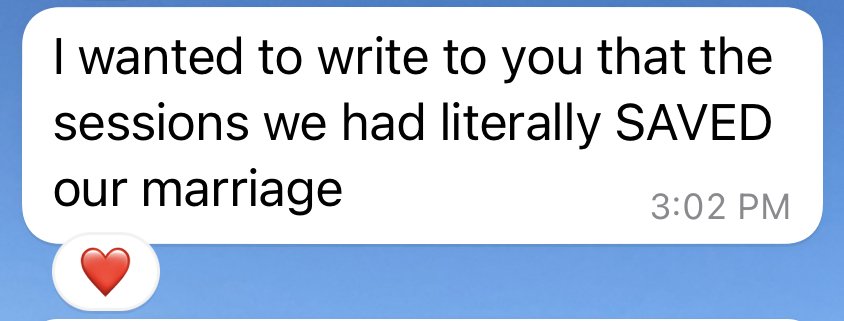
“When we reached out to begin working with you, we were a mess.
My husband had recently shared with me that he’s been struggling with sex addiction for the past four years of our marriage. My husband did not have a job and I was leaning towards divorce.
Basically there was chaos and discord in our relationship and in our home. We felt distant and we were fighting and arguing basically every day.
We scheduled a consultation with you and that planted the seed for change. You shared that it is possible for us to have a loving, intimate, erotic relationship if we were willing to show up for each other.
Two days later my husband had his first session with you. A week later my husband was hired for an amazing job with major earning potential. Beyond our wildest dreams. It’s still a work in progress but my husband started taking responsibility for his part in the relationship. I began leaning more into my femininity.
My whole life I was told that the woman is responsible for the dynamic in the relationship between a man and woman. It felt so heavy, so lonely, so masculine to try and control and hold the relationship, and all the household responsibilities. It was too much.
And here you came and said to my husband, you take the lead, you take the responsibility, you show up. How liberating. How freeing. I began to find my breath. I began to feel safe in my home.
It’s not perfect but we began to feel some hope. That staying together is a possibility. That I can feel safe with my husband and call his bullshit when I see it. That he is lucky to have me and that I can be the princess in the fairy tale and in love in my marriage.
So thank you from the bottom of my heart for showing us this possibility.”

“Probably the greatest gift of my lifetime was my journey with you in your place. How you were so present for me and held space in such a beautiful way. I’m so grateful for you brother ❤️. That’s what you gift people. The safety to let go of their pain and connect to self and see their own beautiful light.”
“Saadya exudes a caring warmth and deep presence that facilitated my healing process. He shows up in mind, body and spirit in a rare way that I have not seen from other therapists. I am grateful to him and for the work we did together.”
“I haven’t felt this relaxed my entire life. I might even be able to stop taking my blood pressure medication.
Most of my anxiety is completely gone. And when it starts coming back I can very, very easily reach back to what happened during that trip and keep it at bay. And whatever I learned during that trip is still guiding me till today: it’s at the forefront of my mind and guiding my every step.
So that was an absolutely life changing experience. It changed everything. And I’m going forward based on what I learned during the journey. I am eternally grateful to you for what happened that night.”

“Dear Saadya,
When we first met five months ago, I told you about my 27 years of excruciating pain and everything I did to try to alleviate it – including brain surgery, and years of Fentanyl, and every traditional and alternative treatment I could find.
I suffered greatly every day starting in my 20’s, through my 30’s, my 40’s, and now into my 50’s, and the thought of continuing on like that was devastating. I only recently learned about the healing potential of the type of medicine work that you do, and I am so thankful that I was led to you.
This is so hard to describe, but I had an experience in my first journey that made it unequivocally clear that my pain, however excruciating it is, has absolutely no meaning, and is nothing to fear. This truth has remained with me, and I am no longer suffering.
In my second journey I had the overwhelming realization that I have inside me an extremely strong inner self – one that has been with me all along and has gotten me through so much hardship in the best possible way.
Before this, I actually doubted that I even had a real core. Now I know with every cell of my body that I am capable of facing any challenge, and when I falter I know I will be whole and secure in the end.
And most importantly I learned this truth: despite all the diagnoses I have been given along the way, there is nothing wrong with me.
The journeys themselves were the most wonderful, magical, life-altering experiences. Your loving presence and guidance, the care and attention you gave to every detail, the way you held a safe and embracing space.
Before experiencing those journeys, I could never have understood how fundamentally they, along with our weekly meetings and my active processing in between, would change every aspect of my life.
In our coaching sessions you not only reinforce what I received from the journeys by giving me a container in which to integrate, but you guide me towards building on all those awarenesses, and continuously growing.
I am unpacking and examining deep sadnesses that have been living inside me for many decades, and one by one they are falling away. I am discovering so many walls that I had to build to protect myself, and those are coming down as well.
I am finally experiencing all the feelings in my body that I had repressed for so many years. I fully trust my self now – a concept I did not even begin to understand before.
My life with my husband, and with my daughter, have also changed in ways they never thought possible. The life I live now is universes away from the life I lived five months ago. I feel so much love around me that I never knew was there, and the gratitude I feel is overwhelming.
I am now awake, and I love my life so much.
With tremendous love and appreciation,”
If you’re interested in coaching or in-person healing work, please fill out this form.